Login
Log in if you have an account
Register
By creating an account with our store, you will be able to move through the checkout process faster, store multiple addresses, view and track your orders in your account, and more.
Create an account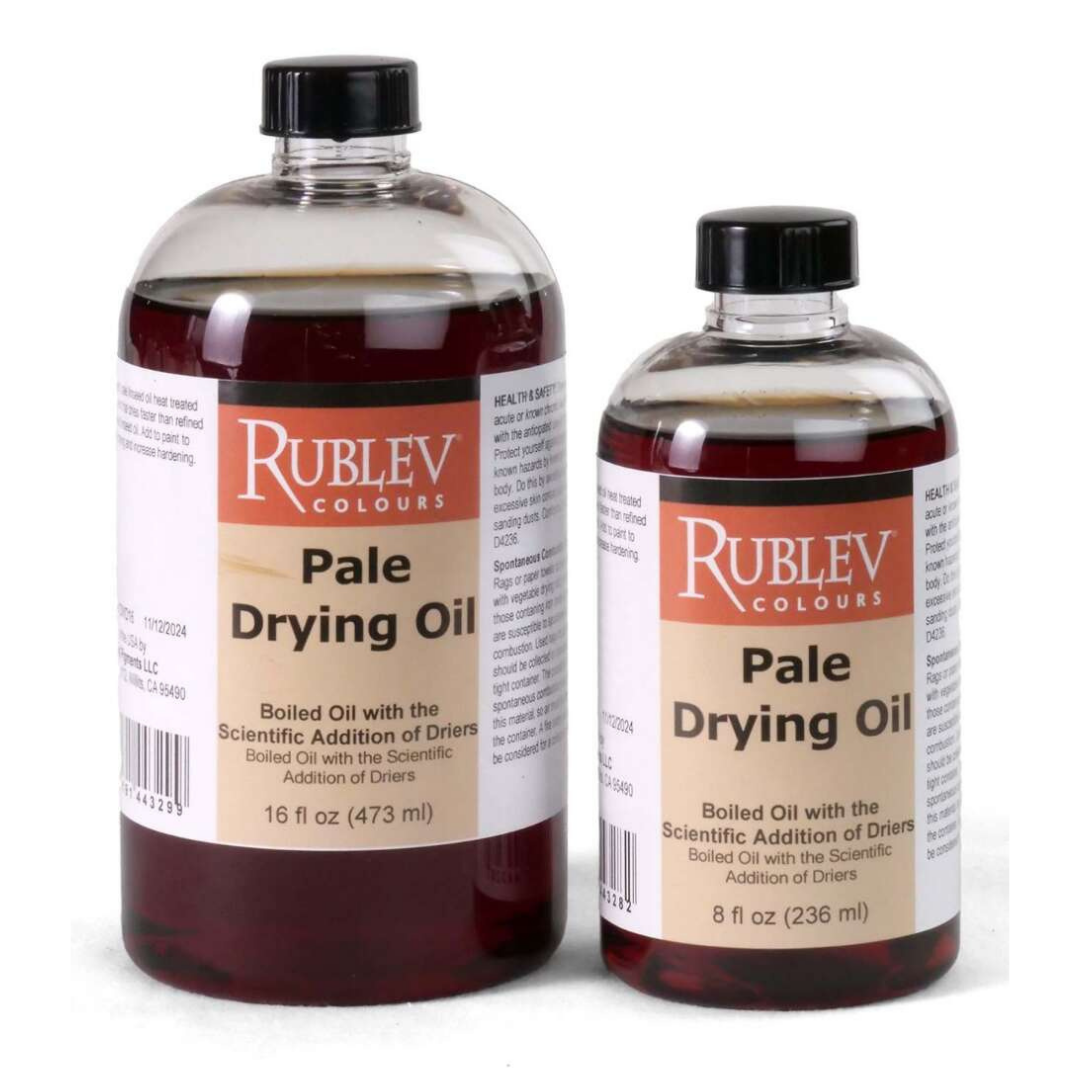
Rublev Colours Pale Drying Oil - 8 fl oz / 236 ml
Pale Drying Oil is made from well-settled, filtered raw linseed oil made from selected North American flax seeds. The oil is heated in closed kettles with the scientific addition of driers. Meets standards in ASTM D 260, Type 1 and Federal Specification TT-L-190.
In the past, before soluble liquid driers were developed, metallic driers could only be dissolved and thus made effective by reacting the metal salt or oxide (such as litharge or manganese borate) with the oil at high temperature. It was therefore necessary to heat or "boil" the oil, if you wanted an oil that already contained a drier. Our pale drying oil is made by heating raw linseed oil at a low temperature to slightly polymerize it and adding liquid driers.
Pale Drying Oil is fast drying. This is the best way to speed the drying of your oil paint. Add small amounts to your grinding oil when making oil colours or add to tube oil paint to promote faster drying. Add to painting mediums and oil colours to speed drying without the danger of adding excessive amounts of driers. This is a good substitute for "black oil" and driers.
Oil Painting Mediums alter the working properties of paint. Although called “mediums,” mediums typically are composed of a binder and sometimes a solvent. Additives, on the other hand, consist of solvents, oils, waxes, resins, extender pigments and other substances that are used to change the consistency of paint. Oil painting additives (or as Natural Pigments prefers to call them “amendments”) are designed to alter the consistency of oil paint in novel ways, different from the varnishes that were introduced into common use during the 19th century. Painting amendments change the handling properties of paint, such as flow out and leveling; increase or decrease tackiness and drag; hasten or retard drying time, increase or decrease gloss, increase transparency, or other characteristics.
In painting, "medium" refers to both the type of paint and an amendment to alter the properties of paint. A painter can prepare a medium with solvents, resins, wax, and other substances in order to control the consistency of oil paint. Often the term "paint medium" refers to the fluid that carries pigments, but this is more properly called a "vehicle," which is typically composed of a solid binder and a solvent or diluent. An example of an artist paint vehicle is watercolor, where gum arabic is the binder and water the diluent or vehicle.
Oil paint is a slow-drying paint consisting of pigment particles suspended in a drying oil, commonly linseed oil. The viscosity of the paint may be modified by the addition of a solvent, such as turpentine or mineral spirits (white spirits), and varnish may be added to increase the glossiness of the dried film. In this article, you will find complete descriptions of oil painting mediums or additives (or as we prefer to call them "amendments") made by Natural Pigments. These amendments are designed to alter the consistency of oil paint in novel ways, different from the varnishes that were introduced into common use during the eighteenth and nineteenth centuries.
Painting mediums can change the handling properties of paint, such as flow out and leveling; increase or decrease tackiness and drag; hasten or retard drying time, increase or decrease gloss, increase transparency, or other characteristics.
| Amendment | Glazing | Impasto | Oiling Out | Drying Time* |
| Paste Mediums | ||||
| Impasto Medium | Yes | Best | No | 2 |
| Impasto Putty | Yes | Best | No | 2 |
| Velázquez Medium | Yes | Best | No | 2 |
| Underpainting Transparent Base1 | No | Yes | No | 5 |
| Gel Mediums | ||||
| Oleogel | Best | Yes | Best | 2 |
| Walnut Oil Gel | Best | Yes | Best | 1 |
| Epoxide Oil Gel | Best | Yes | Best | 3 |
| Oleoresgel | Best | Yes | Best | 3 |
| Wilson's Medium | Best | Yes | Best | 4 |
| Italian Varnish | Best | Yes | Yes | 3 |
| Venetian Medium | Best | Yes | Yes | 4 |
| Fluid Mediums | ||||
| Balsam Essential Oil Medium | Best | No | No | 3 |
| Rublev Colours Oil Mediums | Best | No | Yes | 2–4 |
*Drying Time: 1 for slowest and 5 fastest. Drying time is the amount of time it takes for oil paint to be dry to the touch after application. The paint, however, remains vulnerable to damage from wiping or brushing. As oil paint dries, its solid components adhere to each other, a process called 'curing'. When fully cured, you can apply another layer of paint without fear of harm, wrinkling or cracking. For example, oil paint may dry within 6–8 hours, but cure in 3–7 days.
Notes:
1 Underpainting Transparent Base dries very quickly to a matte surface making it ideally suited for underpainting.
Add your review
Review Rublev Colours Pale Drying Oil - 8 fl oz / 236 ml