


Login
Log in if you have an account
Register
By creating an account with our store, you will be able to move through the checkout process faster, store multiple addresses, view and track your orders in your account, and more.
Create an account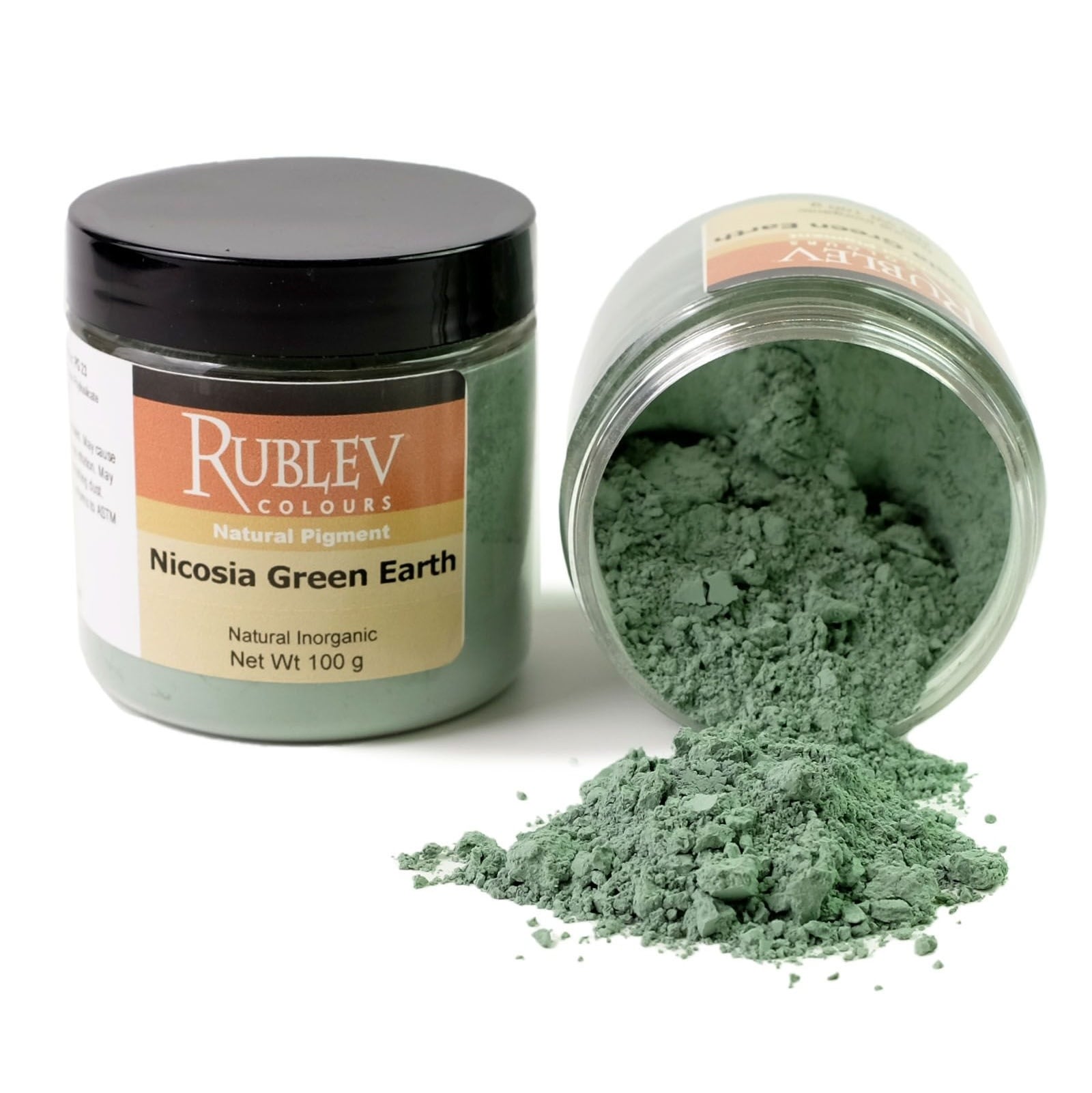
Rublev Colours Pigment Nicosia Green Earth - 100 g
Green earth has good tinting strength and covering power, and the pigment is easily ground. Since it contains some clay, green earth absorbs oil at a moderate to high rate. The cool, strong color of this pigment is partly a function of the synthetic colorants present rather than solely the mineral component.
Earth pigments, particularly green earth, are often described as the most permanent of colors. Earth pigments are not affected by sunlight or by atmospheric conditions. They do not react with solvents, but according to Feller, green earth is partially soluble in acids and alkalies. The phthalocyanine green (PG7) and cobalt compounds (PB36, PG19) present in this product are also rated Lightfastness I by ASTM and are chemically stable and non-reactive in standard painting media.
Green earth, also widely known as terre verte, is primarily composed of the minerals celadonite and glauconite. The presence of celadonite or glauconite, minerals with complex silicate compositions, produces colours ranging from cold bluish greens to warmer yellow and olive hues. It may have originally formed from biotite (a dark-colored mica), but other minerals, and even organic matter, may convert it into glauconite. The mineral has a micaceous structure, a silicate crystallized in monoclinic forms that readily separates into very thin leaves. It is characteristically formed on submarine elevations of ancient seabeds ranging in depth from 30 to 1,000 meters (100 to 3,300 feet) below sea level and in the sedimentary rocks of different geological systems. Usually, it forms small (from 0.8 to 1.5 mm in diameter) green, round, or angular grains.
The most famous deposit of green earth was found near Verona, Italy, and this mine was active until World War II. Other mines produced variations in the pigment's color and texture: the Baltic states, Bohemia, Cyprus, France, Hungary, Poland, Saxony, Tyrol, and the Mendip Hills of England. Our green earth is from Cyprus, where well-known glauconite deposits are found today.
Glauconite is not found in nature as large accumulations but in combination with clay or sand. Its content rarely exceeds 50% of the deposit, making it necessary to process the mineral as a pigment. The preparation of glauconite is usually done with levigation, sifting, and sometimes electromagnetic separation. Sometimes clay or sandy minerals, tinted with aniline red or copper pigments, have been marketed under the guise of glauconite. Ethyl alcohol can detect the presence of aniline red while mixing a sample with ammonium hydroxide can reveal the presence of copper-based colors. Modern analytical methods — particularly Raman microspectroscopy — are necessary to detect synthetic organic and inorganic adulterants such as phthalocyanine green and cobalt compounds, which are not reliably detectable by the traditional wet chemistry tests described above.
The mineral earth component of this pigment is considered non-toxic, but care should always be exercised when handling the dry powder pigment to avoid inhaling the dust. The cobalt compounds present in this product carry the standard handling considerations common to cobalt-containing pigments; avoid inhaling dry pigment dust.
Add your review
Review Rublev Colours Pigment Nicosia Green Earth - 100 g