

Login
Log in if you have an account
Register
By creating an account with our store, you will be able to move through the checkout process faster, store multiple addresses, view and track your orders in your account, and more.
Create an account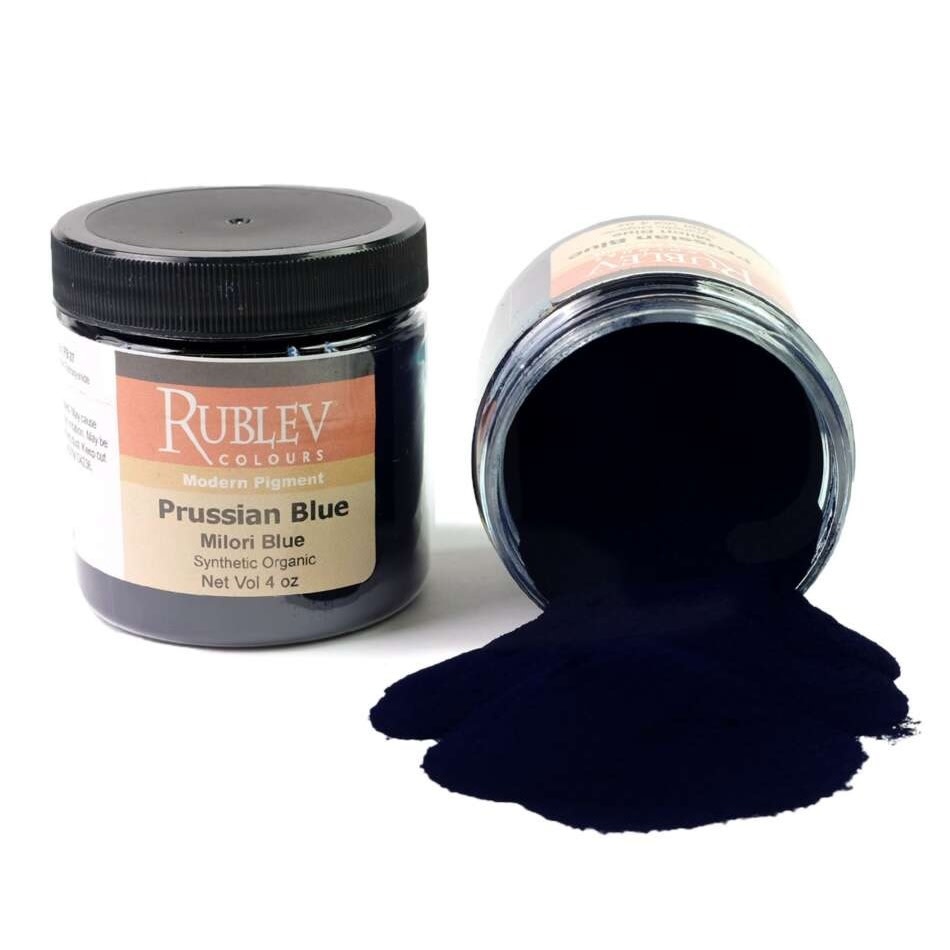
Prussian Blue is made according to the process originated by the French colormaker, Milori & Company, Lyons, France, known as the Milori process.
Permanence and Compatibility
Prussian Blue is stable in weak acids but decomposes in weak alkalis, so it is suitable for oil, encaustic (non-emulsified or saponified), egg tempera, and watercolor, but not fresco and casein.
Unlike mineral pigments, Prussian blue does not have formal Mohs hardness values. Both are synthetic coordination/organic pigments, so hardness—defined for crystalline minerals—doesn’t strictly apply. That said, their effective or functional hardness in artists’ materials can be described accurately. Prussian blue forms a coordination polymer with relatively weak lattice cohesion compared with oxides. Pigment particles are soft, friable, and readily fractured. The practical implications are very low abrasiveness, negligible tool and surface wear, which contributes to soft handling, but poor lightfastness and sensitivity in some binders and environments.
Oil Absorption and Grinding
Prussian Blue absorbs a moderately high amount of oil (40–50 grams of linseed oil per 100 grams of pigment) to make a paste.
Toxicity
Prussian Blue is not considered toxic; however, care should be taken when handling the dry-powder pigment to avoid inhaling dust.
Add your review
Review Rublev Colours Pigment Prussian Blue - 4 oz